
Accipiter Radar provides drone detection for Blue Angels
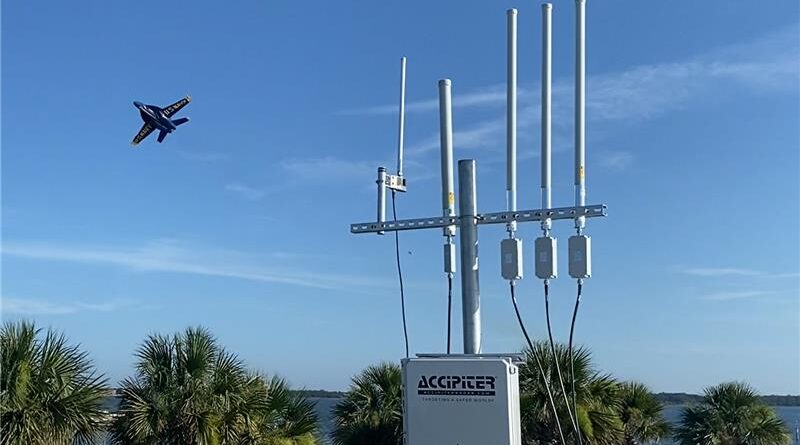
Accipiter Radar was in Florida earlier this month with the Blue Angels providing invaluable drone detection service to the US Navy and its partners. The Blue Angels inspire a culture of excellence and service by representing the United States Navy and Marine Corps to audiences globally through their awe-inspiring and well-known air shows. Accipiter Radar worked closely with Airspace Link, Inc. and Seneca Nation Group during the July 2025 Pensacola Blue Angels Annual Beach Air Show, helping protect the Blue Angels and other participating aircraft from clueless and careless drones in the airspace. Accipiter’s drone detection sensors and services were deployed for use by a multiagency contingent in Escambia County to support safe flight operations throughout the airshow. Airspace Link’s Drone Operations Management System (DOMS) was fed in real-time by Accipiter’s Counter UAS Smart Surveillance Network and assisted in securing the operational airspace. Chief Greg Campenella of Escambia County Fire and Rescue explains: “This collaboration effort showcased a new level of innovation in air space control, management, and collision avoidance, helping maintain a sterile air space throughout the event. It was an amazing experience.” “Drones bring an exciting promise of transforming air mobility, but drones are as difficult for pilots to see as birds and can cause even more damage” notes Dr. Tim Nohara, President, and CEO of Accipiter. Dr. Nohara goes on to explain, “aviation safety can be maintained by having both drone operators and crewed pilots share the safety responsibility of airspace.” Accipiter Radar continues to be a leader in Smart Surveillance Networks and automated decision support capabilities for new applications and threats which provide force multiplication and enable information sharing and interoperability with practitioners who work together to keep us safe. About Accipiter Radar Accipiter Radar is a North American company that develops, sells, and operates high-performance radar and sensor intelligence networks engineered to monitor the environment and characterize the behavior of targets such as small vessels, low flying aircraft, vehicles and birds, as well as distributed phenomenon such as weather, waves and snow/ice. The result is enhanced wide-area safety and security through unprecedented domain awareness for 21st century applications in homeland security, aviation safety and security, and environmental protection. Accipiter Radar Technologies Inc. of Niagara, Ontario Canada and Accipiter Radar Corporation of Niagara, New York, USA are Targeting a Safer World® and have won business from of all levels of government in North America, as well as major corporations and governments in various parts of the world. For more information visit www.accipiterradar.com Or contact: Dr. Tim J. Nohara President & CEO, Accipiter Radar info@accipiterradar.comDownload PDF
Dr. Tim Nohara of Accipiter part of Detroit Advanced Air Mobility Ecosystem Expert Panel
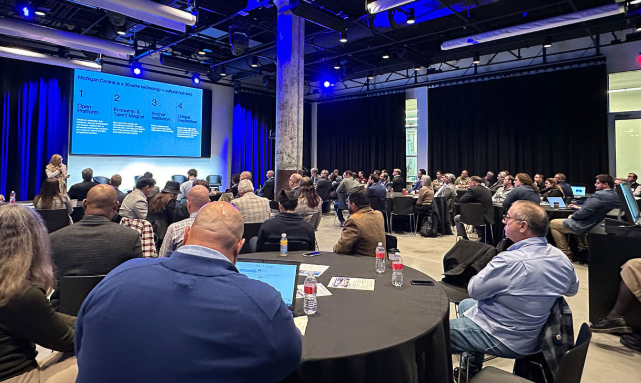
In the heart of Motor City, a new era of aviation has started to unfold. Detroit, long known for its automotive innovation, is now positioning itself as a hub for Advanced Air Mobility (AAM). With Michigan’s unique blend of automotive innovation, technological infrastructure and strategic vision, the state aims to transform from an automotive powerhouse to a cutting-edge mobility laboratory. This article explores how several key organizations—Airspace Link, uAvionix, Accipiter Radar and the Michigan Central Innovation District—are collaborating to create a robust ecosystem that supports the integration of drones, and eventually larger air taxis, into the national airspace. Read on as we delve into the critical components Detroit has blended for successful AAM integration, from funding and physical infrastructure to software, communication and airspace awareness systems. Expert panel from the AAIR Forum, R to L: Dr. Tim Nohara – President & CEO, Accipiter Radar, Jim Cieplak, uAvionix and Michael Healander, Co-Founder, President & CEO, Airspace Link The Michigan Advantage: Detroit’s Mobility and Innovation Ecosystem Detroit’s unique blend of urban infrastructure, technological prowess and manufacturing heritage makes it an ideal testbed for AAM. The city’s commitment to innovation seems evident in the collaborative efforts between industry leaders, government agencies and academic institutions. A Comprehensive Mobility Strategy Michigan’s strategy for a thriving mobility ecosystem extends beyond traditional automotive mobility to include AAM and drone technology. With ongoing investments in infrastructure, technology and human capital, the city of Detroit, in particular, continues to build on its automotive heritage and embrace the future of mobility to position itself as a global leader in the development and implementation of AAM solutions. Justine Johnson, Chief Mobility Officer for the state of Michigan, highlighted the state’s comprehensive approach to mobility innovation that includes various state departments. “We’re utilizing clean energy to help move people, goods and information across land, water and air,” Johnson explained. The state created noteworthy mobility programs, such as the Michigan Mobility Pilot platform. This platform has facilitated dialogue between traditional aviation and the future of air mobility. The Advanced Air Mobility Activation Fund As further evidence of the state’s commitment to innovation it has, along with Michigan Central, invested millions of dollars into AAM. One key example, the Advanced Air Mobility Activation Fund, a partnership between the Michigan Department of Transportation and the Office of Future Mobility and Electrification, aims to support projects that address real-world problems, particularly in rural areas, by leveraging drone technology for medical supply delivery and other critical services. They do this in the Michigan Central Innovation District, a literal and figurative launchpad for AAM technologies. The Michigan Central Innovation District: A Living Laboratory Among other features, the Michigan Central Innovation District includes a three mile radius urban testing ground for AAM so companies can evaluate their operational solutions in real-world scenarios and accelerate the path to commercialization. This summer, Michigan Central celebrated the opening of an Operations Center in the historic Michigan Central Station building. Next on tap: a 14th-floor Air Traffic Control tower. In the meantime, today, real-world drone deliveries have already started taking place as part of pilot programs from the roof of the Newlab, a mobility startup hub located on the Michigan Central innovation campus next door to the future Air Traffic Control tower. Michael Healander, Co-Founder, President & CEO of Airspace Link, highlighted the district’s significance. “This is a really new opportunity for businesses,” he said. “We’re not just talking about first responders or infrastructure inspections. We’re creating a sustainable business environment where companies can operate and scale with customer demand.” As the Detroit AAM ecosystem evolves, it continues to attract businesses and innovators from around the world. The Michigan Central Innovation District, with its state-of-the-art facilities and supportive environment, is fast becoming a magnet for companies looking to develop and test their AAM technologies in real-world conditions. View of a drone flying over Detroit from the roof of Newlab, the startup partner to Michigan Central that runs the innovation ecosystem. Leveraging Infrastructure for Integration: The Companies Making AAM Happen In the meantime, a public-private partnership grows in the background to turn these AAM dreams into reality. Airspace Link, uAvionix and Accipiter Radar continue collaborating with the Michigan Central Innovation District to provide the infrastructure backbone necessary to integrate AAM into Detroit’s skies. These industry partners work together to address challenges such as: integrating unmanned aircraft with traditional aviation traffic, developing robust detect-and-avoid systems, ensuring reliable communication links between ground control and drones and mitigating potential conflicts with birds and other airspace users. Airspace Link: The Connective Tissue Airspace Link’s AirHub Portal platform serves as the connective tissue for the AAM ecosystem in Detroit and beyond. Through its digital platform AirHub Portal, Airspace Link provides crucial services like B4UFLY and LAANC, while also offering customized solutions such as the community-oriented FlySafe Program. This comprehensive approach enables Airspace Link to equip pilots, municipalities, and local populations with the tools to adopt drone technology with assurance and expand their operations. With an average of 30,000 flight planning efforts per day and thousands of FAA authorizations processed, the company stands at the epicenter of drone integration. Healander outlined five critical components that Airspace Link literally links together: hardware and infrastructure, software, drone OEMs and operators, governance and policy and business operations. By harmonizing these elements, Airspace Link has created a scalable model that can be replicated across the country. “We have over 5000 businesses and government agencies on our platform today,” Healander explained. “From small two-person drone operations to major players like the Air Force and UPS, we’re supporting just about every type of operation you can think of right here in Detroit and in other areas. We welcome you to come too.” uAvionix: Enhancing Communication Infrastructure Jim Cieplak, a consultant at uAvionix, who brings decades of experience in both manned and unmanned aviation to the Detroit AAM ecosystem, described how uAvionix has developed robust communication systems that enable drones to interact seamlessly with existing air traffic control networks. The company facilitates advanced operations by offering